)
Tavarnelle
)
Castello del Nero - Torrigiani
This villa has been converted into luxury hotel accommodation in recent years.
|
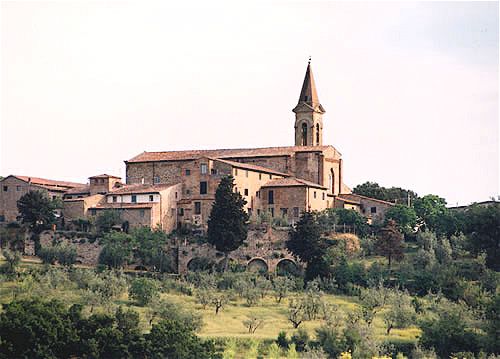
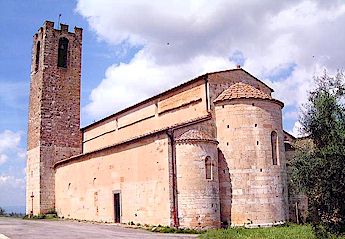
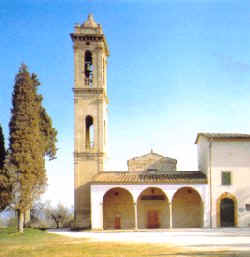
Tavarnelle Val di Pesa is of ancient origin but the current town is quite modern in appearance and in fact acquired such importance as it has in relatively recent times. It takes its name from its location in the valley of the river Pesa. Within Tavarnelle itself, the Church of Santa Lucia al Borghetto is the most interesting architectural sight, being a rare example of Tuscan Gothic architecture. Nearby there are several extremely interesting structures, notably the parish church of San Donato in Poggio, the parish church of San Pietro in Bossolo which now houses the Museum of Religious Art of Tavarnelle, and the large and important monastery of Badia a Passignano. Details below.
|
Storia di Tavarnelle in italiano
History of Tavarnelle
The first mention of the town of Tavarnelle dates back to a map of the year 780, with the name Tabernulae,
possibly referring to the taverns located here on the road from Florence
to Siena, but a much older origin is likely. In the square in front of the Church of S. Pietro in Bossolo, previously S. Petrus in Pixide and built towards the middle of the eleventh century, ruins have been found that are thought to belong to a church built in the fourth century, and tombstone belonging to the tomb of Almemanna, spouse of Flavius Faustinanus, has been found, dating back to 424. The Val di Pesa, as well as the neighbouring
Val
d'Elsa, was already densely populated in the eight and seventh centuries BC, and quite important Etruscan settlements have been discovered in the
area. The town of Tavarnelle then developed with the union of three mediaeval hamlets: Tavarnelle, Borghetto and Mocale, located on crossroads between Florence and the
mediaeval
Via Francigena road in Val d'Elsa, later known as Strada Romana, from Rome to beyond the Alps.
|
|
|
|
)
|
|
|
|
|
|
|
|
|
|
|
|
|
|
|
|
|

|
|
|
Web
hosting, web design, content management by ammonet InfoTech
Copyright © ammonet InfoTech 1998 - 2020. All rights reserved.
)
)
)
)